
A“maize”ing Rim Sherd
In the early spring of 2003, a large pottery rim sherd was surface collected from the site now designated as EbKb-37 (also known as the Sand Spit site). The height of the sherd (measured vertically from lip of the rim down to where the break occurs along the base) is approximately 9 centimetres while the width (measured horizontally from broken edge to broken edge) is about 11.5 centimetres. To view a 3-D scan of this rim sherd please click on the attached link provided courtesy of Lakehead University anthropology department.
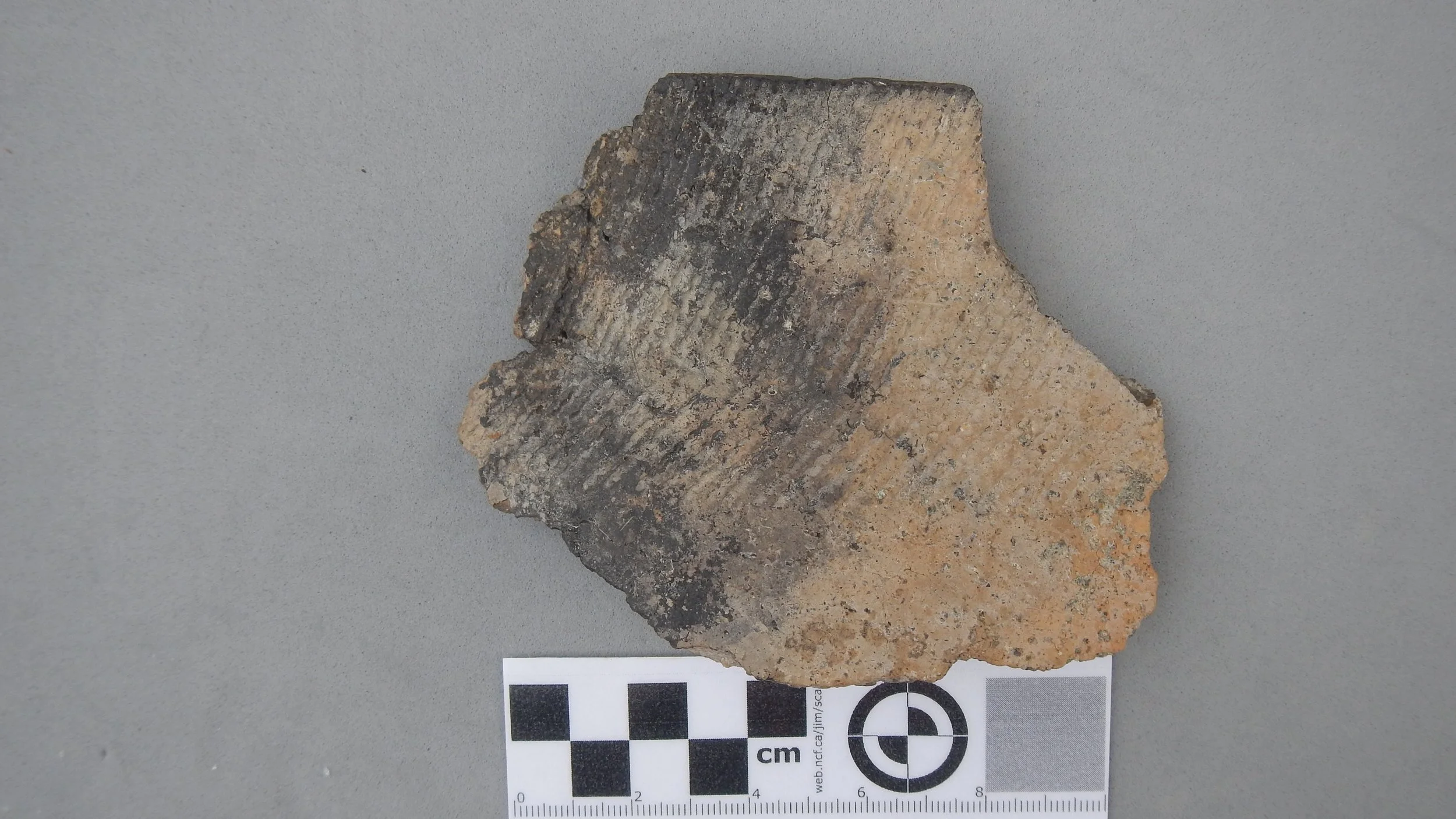
Large Middle Woodland rim sherd with exterior Pseudo Scallop Shell (PSS) stamping
The exterior decoration on this rim consists of three vertical rows of Pseudo Scallop Shell (PSS) stamps applied so that (bottom to top) the stamp is slightly angled right. An encircling line of exterior bosses is placed between the first and second row of PPS stamps. The lip is plain while the interior decoration consists of punctates that created (and correspond to) the design element of exterior bosses. Based on the characteristics of this sherd (including the decorative motiff), this pottery rim is classified as Laurel and is assigned to the Middle Woodland Era.
Another interesting feature observed on the interior of the rim was an adhesion of encrusted carbonized residue that stretched from the lip (top) of the rim down to beyond the interior line of punctates. This material was carefully removed by lightly flaking with a surgical implement while using magnification to view the surface of the sherd. A total of 154.5 milligrams of material was recovered during this process. Of this amount 33.2 milligrams was used (leaving a remaining sample of 121.3 milligrams) to carry out a starch and phytolith analysis in order to test for the presence of plant material contained within the encrusted residue. To view another example of residues on pottery sherds see the cool discovery “encrustations”.
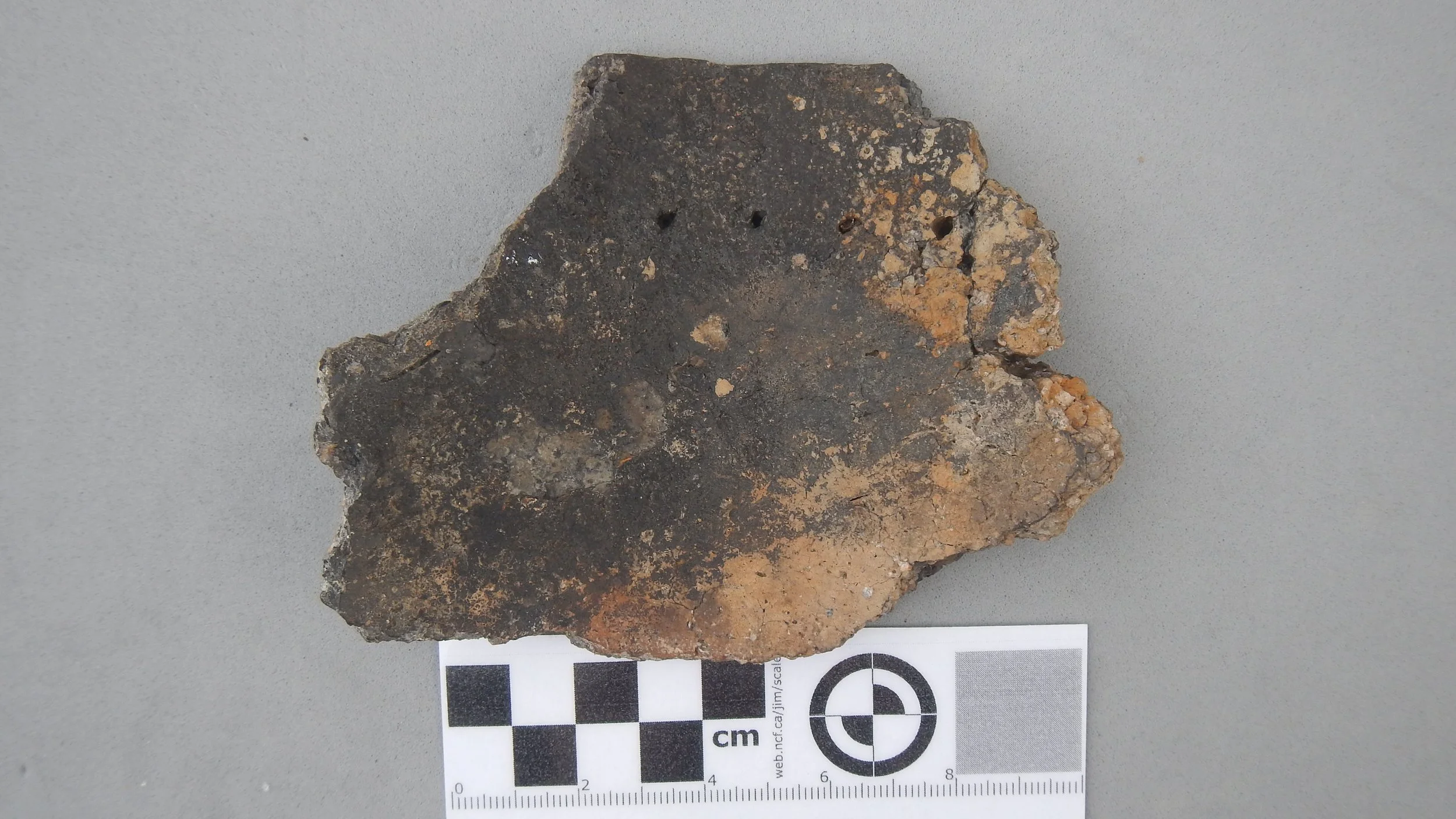
Rim sherd interior surface with dark stains showing location of carbonized residue
The results of the analysis were incredible! Although wild rice was not present, it is important to note that false negatives for wild rice are possible as the microfossils of this plant tend to be quite rare in residues. On the other hand, the sample did test positive for the presence of both maize and beans! According to Dr. Matt Boyd at Lakehead University, carbonized residue on a sherd could represent only a single meal and possibly be a reflection of dietary ‘randomness’. Despite this fact the result is still truly amazing (a”maize”ing) especially when considering the geographical positioning of Lac Seul within the boreal forest region of Canada. Further information and a more detailed discussion pertaining to the distribution of maize within northern Canada can be obtained by reading the 2010 paper “Northernmost Precontact Maize in North America” written by Matthew Boyd and Clarence Surette.
In addition to this exciting research, a portion of the remaining carbonized residue from the rim sherd was sent for radiometric carbon testing as a component of an honours thesis (Moore n.d.) completed at Lakehead University. The results yielded a conventional age of 1670 +/- 30 years BP (Before Present) with 2 Sigma Calibration dates as follows: Cal AD 265 to 275 (Cal BP 1685 to 1675) and Cal AD 330 to 420 (Cal BP 1620 to 1530).
Based on this data, the pottery rim sherd illustrated above is a piece of a pot that had corn and beans cooked in it and this activity took place on Lac Seul (located within the boreal forest) over one thousand years ago! That is a cool discovery!
